
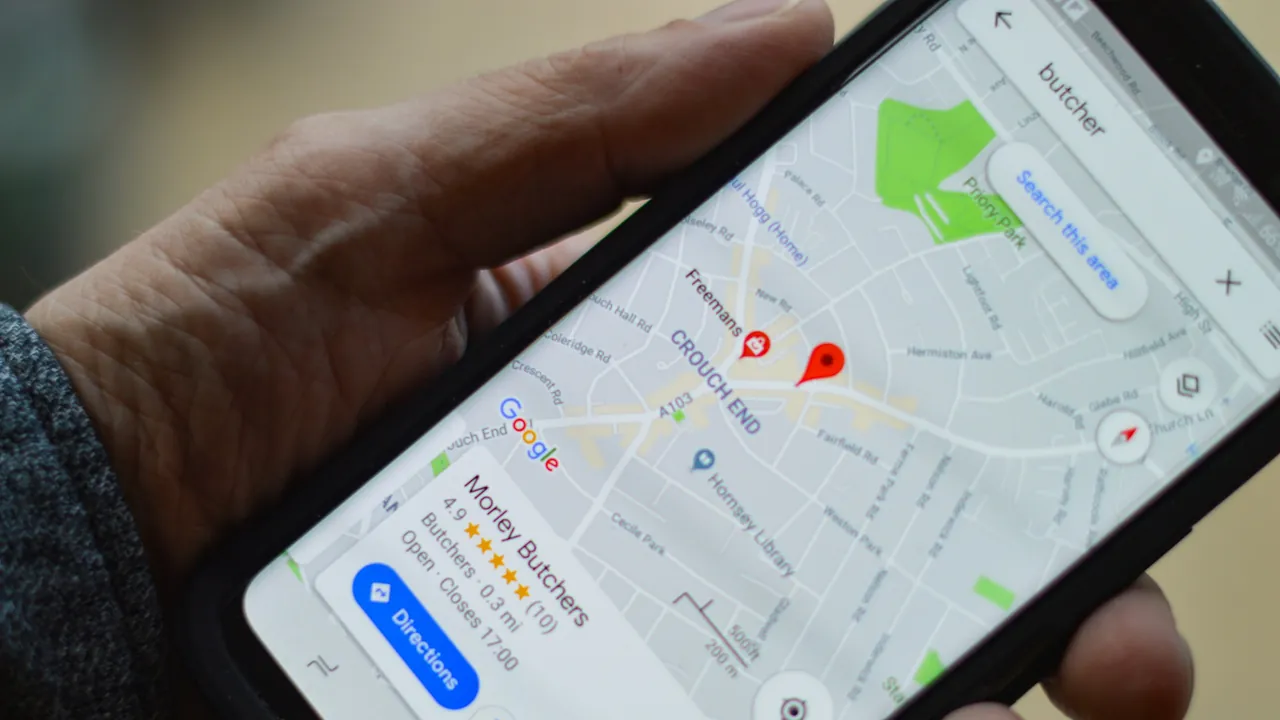
To get into the Google Map Pack in the Georgian Bay area, claim and fully complete your Google Business Profile, pick the right primary category, earn fresh reviews steadily, build consistent Canadian citations, add LocalBusiness schema to a real town page, and keep the profile active. The Map Pack is the three-business map box at the top of local results. It shows on 93% of local-intent searches, its top three results take about 42% of the clicks (2026 local SEO data), and placement there is the single biggest local-search win available. The twelve tactics below are in priority order from highest-impact to nice-to-have.
Local search drives real visits and sales in cottage country. About 46% of Google searches carry local intent, mobile “near me” searches have grown roughly 900% in two years, and 76% of local-intent searches lead to a store visit within 24 hours (Digital Applied, BizIQ, 2026). For a plumber, HVAC contractor, electrician, roofer, contractor, or landscaper here, the Map Pack is where the phone rings.
1. Claim and fully complete your Google Business Profile
Your Google Business Profile (GBP) is the free listing that powers your spot in Maps and the Map Pack. GBP signals account for roughly a third of what decides local pack visibility (2026 local ranking data), so a half-filled profile is the most common reason good businesses stay invisible. Fill every field: business name, exact address (or service area for service-area businesses), hours including statutory holidays, services list with descriptions, products if relevant, attributes (wheelchair-accessible, free Wi-Fi, etc.), and at minimum 20 real photos. This step alone often moves rank 1-3 positions inside a month. A laundromat we took over in June 2026 went from 11 profile calls a month to 26 largely on this kind of groundwork, with direction requests up 40% year over year. One caution on the name field: edit it only when your legal name actually changes, because a name edit can push the profile back into verification. And leave the map itself to Google, which controls the basemap right down to showing US and Canadian users different names for the same lake.
2. Choose the right primary category
Your primary GBP category is the strongest single category signal Google reads. Pick the most specific one that matches your core service (“Plumber” not “Contractor”, “HVAC contractor” not “Heating contractor”), then add 4 to 8 relevant secondary categories. The wrong primary category caps how high you can rank no matter what else you do; we have watched contractors leap from Map Pack position 8 to position 2 within 6 weeks after fixing nothing else but the primary category. The full per-trade reference is in our GBP categories that actually rank for Collingwood trades post.
3. Use the way cottage country actually searches
Seasonal visitors and cottagers search “[service] Collingwood” or “[service] Blue Mountain”, not “near me”, because they are searching for a place they do not currently live. Build and optimise a page for each town you serve using that exact pattern, rather than relying on proximity-based “near me” demand that locals alone generate. Each town page should have real, town-anchored content (neighbourhood names, town-specific market dynamics, town-specific FAQs) rather than a template with the name swapped in.
4. Earn fresh Google reviews on a steady cadence
Reviews are customer ratings on your GBP, and they now account for roughly 20% of Map Pack ranking factors, the second most important signal (2026 review data). Volume is not enough; recency matters. Fresh reviews can lift rankings by up to about 15% versus a profile that has gone quiet, so aim for a steady trickle every week rather than a one-time burst. The number you actually need depends on what your competitors have; for the specific calculation and target review counts by trade in Collingwood, see our how many Google reviews you need to rank in Collingwood breakdown.
5. Respond to the reviews you get
Responding to reviews is both a trust signal and a ranking signal. Businesses that respond to more than 80% of their reviews see a roughly 10 to 20% ranking boost, and 97% of people who read reviews also read the owner’s responses (2026 review data). Reply to every review, good or bad, in your own plain voice. A thoughtful response to a 2-star review converts better than no response to a 5-star review, because future readers are watching how you handle pressure. The recommended cadence: every review responded to within 24 hours, weekdays.
6. Keep your name, address, and phone identical everywhere
NAP consistency means your business name, address, and phone number are written exactly the same on every website, directory, and profile. Inconsistent NAP splits your identity in Google’s eyes and drags down rankings. Lock one format (for example “(705) 539-0398”, written the same way every time, “Acme Plumbing Inc” not “ACME Plumbing” elsewhere) and use it everywhere. The single most damaging inconsistency type is different phone numbers across directories, which triggers Google’s “this may not be the same business” filter. For the audit-and-fix sequence, our NAP consistency post walks through the 30-minute fix.
7. Build citations on Canadian and regional directories
A citation is any online mention of your NAP, such as a directory listing. Consistent citations on Canadian and regional directories confirm to Google that your business is real and local. Prioritise Canada-focused and Georgian Bay area directories over generic global ones for the local relevance weight. The 42 directories worth claiming for a Georgian Bay shoreline business in 2026 (Tier 1 through Tier 5) are listed in our Collingwood citation list, along with the ones to skip because they waste time or actively hurt ranking.
8. Add LocalBusiness schema to your town pages
Schema is structured code that tells search engines exactly what your business is, where, and what it offers. Adding LocalBusiness schema (or the appropriate Schema.org subtype: Plumber, HVACBusiness, RoofingContractor, Electrician) to each real town page makes your location, service area, and hours machine-readable, which helps both the Map Pack and AI answer engines quote you correctly. The exact JSON-LD blocks for trades, copy-paste-ready, are in our schema markup guide for Georgian Bay service businesses.
9. Build one strong page per town, not a thin one for fifty
A town page should have genuine, specific content about serving that town, not a template with the name swapped in. Thin, near-duplicate location pages get ignored or filtered by Google’s quality systems and can drag down ranking of your stronger pages. Six strong town pages beat fifty weak ones, both for users and for Google. Each town page should include town-specific market dynamics, real neighbourhood names (Cranberry, Craigleith, Lora Bay, Beach Areas, Sunnidale Trails, Bruce Peninsula towns), an embedded map, and town-anchored FAQs. The same logic applies to trade-in-town pages; the per-town SEO playbooks for Collingwood, Blue Mountain, Wasaga Beach, Thornbury, Meaford, and Owen Sound each go deeper on town-specific tactics.
10. Keep the profile active with posts and photos
Google rewards active profiles. Regular Google Business Profile posts (weekly is the right cadence), fresh photos of real jobs uploaded monthly, and updated hours signal that the business is live and current. An active profile holds its ranking; a dormant one slips as fresher competitors pass it. Photo recency specifically is one of the under-appreciated GBP signals: a profile with 30 photos from 2022 and nothing since signals “may be closed” more strongly than a profile with 10 photos from this quarter.
11. Earn local links and mentions
A local backlink is a link from another Georgian Bay area site, such as a chamber of commerce, local news outlet, supplier, or community organisation. Local links carry strong local relevance and are hard for out-of-town competitors to copy. The specific tactics that work in this corridor: join the Collingwood, Blue Mountains, or Wasaga Beach chamber of commerce (member directory listing); pitch a guest column to CollingwoodToday.ca or other local news; get listed by your suppliers, trade-association directories, and industry partners; sponsor a local event for a community recognition link. Three to five strong local links over a year outperform fifty generic directory submissions.
12. Track your Map Pack rank by town
You cannot improve what you do not measure. Because rankings vary by physical location, check where you sit in the Map Pack from each town you serve, not just from your office or kitchen table. Track the top three for your core “[service] [town]” searches monthly and let the gaps set your next move. Free tools (Google Search Console plus incognito searches with location set) cover the basics; paid grid-based local rank trackers like Local Falcon show the full picture across your entire service area, which is what we use for clients. The key insight: ranking varies dramatically across a service area, so a single rank check from one location is misleading.
What should you do first this week?
If you are starting from a half-filled GBP and no SEO foundation, the order of local SEO work that produces fastest movement:
- Week 1: Fix your primary category (#2), claim and complete your GBP (#1). These two alone often move rank within a month.
- Week 2-3: Audit and fix NAP consistency across your top 15 citations (#6). The unglamorous work that compounds.
- Week 3-6: Set up automated review requests after every completed job (#4). Target 3 to 5 reviews per week minimum. Reply to all reviews within 24 hours (#5).
- Month 2: Build or rewrite one location page per town you serve, with real local content (#9). Add LocalBusiness schema (#8).
- Month 2-3: Build out the remaining Canadian citations from the Tier 1 and Tier 2 list (#7).
- Month 3 onwards: Steady cadence of GBP posts and photos (#10), pursuit of 1-2 local backlinks per quarter (#11), monthly rank tracking by town (#12).
Most operators see meaningful Map Pack movement at 6-8 weeks if the foundations were broken before, and top-3 position in 4-6 months for competitive Collingwood-area trade keywords. Less competitive towns (Thornbury, Meaford) move faster; more competitive ones (Collingwood, Owen Sound) take the full 4-6 months. The full Collingwood-specific playbook context is in our Collingwood local SEO cornerstone guide.
Frequently asked questions
What is the Google Map Pack? The Map Pack is the box of three local businesses shown on a map at the top of Google’s local results. It appears on about 93% of local-intent searches, and its top three results capture roughly 42% of clicks (2026 local SEO data). For a service business, Map Pack placement typically drives 60% to 70% of search-originated phone calls.
How do I rank in the Map Pack in Collingwood? Claim and fully complete your Google Business Profile, choose the right primary category, earn fresh reviews steadily (3 to 5 per week minimum), keep your NAP consistent across the top 15 Canadian directories, build a real town page for each town you serve with LocalBusiness schema, and keep the profile active with weekly posts and monthly photos. Then track your rank by town monthly and let the gaps set your next move.
How long does it take to show up in the Map Pack? Movement usually shows over 4 to 12 weeks as profile signals, reviews, and citations accumulate. Reviews are about 20% of the ranking factors and respond fastest, so a steady review cadence is often where you see the earliest gains. Top-3 position in competitive Collingwood-area trade keywords typically takes 4 to 6 months of consistent work.
Do reviews really affect Map Pack rankings? Yes. Reviews account for roughly 20% of Map Pack ranking factors, responding to more than 80% of reviews correlates with a 10 to 20% ranking boost, and fresh reviews can lift rankings by up to about 15% versus a quiet profile (2026 review data). The specific review-count targets by trade for Collingwood are in our reviews-to-rank breakdown.
How many towns can one business rank in? As many as you genuinely serve and can support with a real page each. Local relevance is strongest where you have a true presence, so most service businesses do best ranking in two to five nearby towns done well rather than spreading thin across fifteen weak pages. Our trade-in-town SEO playbooks cover each town in the Georgian Bay shoreline corridor.
What is the difference between Map Pack and organic results? The Map Pack is the 3-business box with the map. Organic results are the standard blue-link results below it. Both matter for service businesses but in different ways: Map Pack drives 60-70% of clicks on emergency and “near me” intent; organic drives most clicks on research-phase queries like “best contractor for kitchen reno Collingwood”. The breakdown by query type is in our Map Pack versus organic post.
By Lasse Pettersen, Georgian Bay SEO, Collingwood, Ontario. Local SEO for trades and service businesses along the Georgian Bay shoreline. Free 15-minute audit at https://georgianbayseo.ca, (705) 539-0398.
Want this run against your own business?
Free 15-minute audit. We pull up Google together and show you exactly where you rank, where you could be in 60 to 90 days, and the cheapest moves to get there.
Prefer to talk? (705) 539-0398