Between July 12 and August 18, 2026 I built and launched nine lead-generation websites for local trades: roofing and eavestrough, electrical, pest control, basement waterproofing, epoxy floor coatings, and water damage restoration. I have built zero backlinks to any of them. No guest posts, no directories, no citations, no outreach, nothing. The first site reached page 3 for its money term inside a month, and on August 21 the first real lead came in: day 40 from the first launch. This is part 1 of a series that will track these sites, with real dates and real Search Console numbers, until they reach page 1 or provably fail.
Why I am doing this in public
Every SEO agency says “we get results.” Almost none of them will show you a site they ranked from zero, with dates attached, where they had no client budget to hide behind. So I am running the experiment on my own money and publishing the numbers as they happen, good and bad. The sites are mine. The domains were registered this summer. Google has no reason to rank them except the on-page work itself.
One honest caveat up front: I am not going to name the sites or their towns. They are live lead-generation assets in competitive markets, some local to Georgian Bay and some in other regions of Ontario, and naming them would hand the playbook to the exact competitors they are built to beat. The professions, the dates, and every number in this series are real, pulled straight from Search Console and my own build logs.
The build timeline
Nine sites went live in 38 days. Here is the actual sequence:
| Date (2026) | What launched | Notes |
|---|---|---|
| July 12 | Site 1: roofing and eavestrough, local | 17 pages, real tracked phone number from day one |
| August 3 | Sites 2, 3, 4: electrical, pest control, basement waterproofing, one mid-size city regionally | Three sites from one shared codebase |
| August 12 | Sites 5, 6: epoxy floor coatings and pest control, local | Domains registered August 11, live the next day |
| August 13 | Sites 7, 8: electrical and roofing, regional | Reused the same templates; two sites in one day |
| August 18 | Site 9: water damage restoration, local | 38 pages at launch |
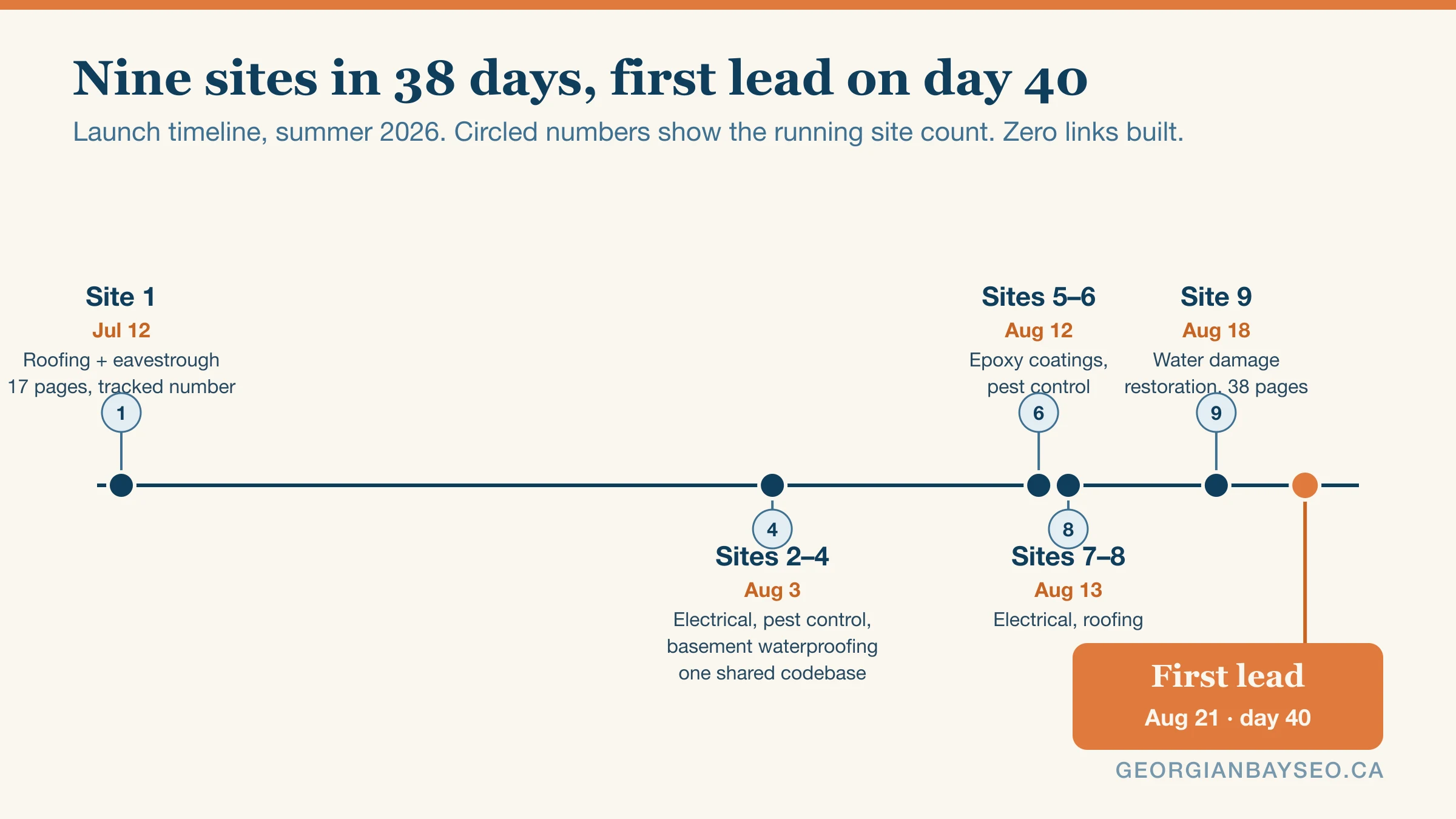
The compounding speed is the point of the shared codebase. Site 1 took weeks of template work. Sites 7 and 8 shipped in a single day because the page templates, schema, and internal-link structure already existed and only the trade-specific content had to be written.
What the work actually is (and is not)
Since there is no link building, everything these sites earn comes from three inputs.
Market selection before a single page is written
I do not pick markets by keyword volume. I download the actual page-1 results for the money term and grade the weakest page that currently ranks: word count, page structure, whether it is a real service page or a thin homepage. If the weakest page-1 incumbent is beatable with a better page, the market is buildable. If page 1 is stacked with deep, purpose-built pages, I walk away no matter how attractive the volume looks. One market I graded this summer looked wide open by reputation and turned out to have three deep incumbent pages; it went to the back of the queue.
On-page work, done completely
Every site gets the same treatment I sell to clients: one service page per job type written around how people actually search (including urgency language for emergency trades), a full heading hierarchy from H1 to H6 with query variations in the deeper levels, JSON-LD schema on every page, internal links between every service page, an XML sitemap submitted to Search Console, and IndexNow on deploy. The same standard I described in the emergency trade SEO playbook applies here, because several of these trades live or die on emergency intent.
Conversion plumbing from day one
Every site launched with a real tracked phone number and a structured lead form, not a placeholder. A ranking with no way to capture the call is a hobby. This matters for the series too: because every call and form fill is tracked per site, the “results” in these posts will eventually be leads, not just positions.
Results so far, from Search Console
These numbers are from Search Console, 28-day windows, measured mid-August 2026.
Indexing is fast. Every site was indexed within about 6 days of launch. A new domain with no links does not have an indexing problem in 2026; it has a ranking-position problem.
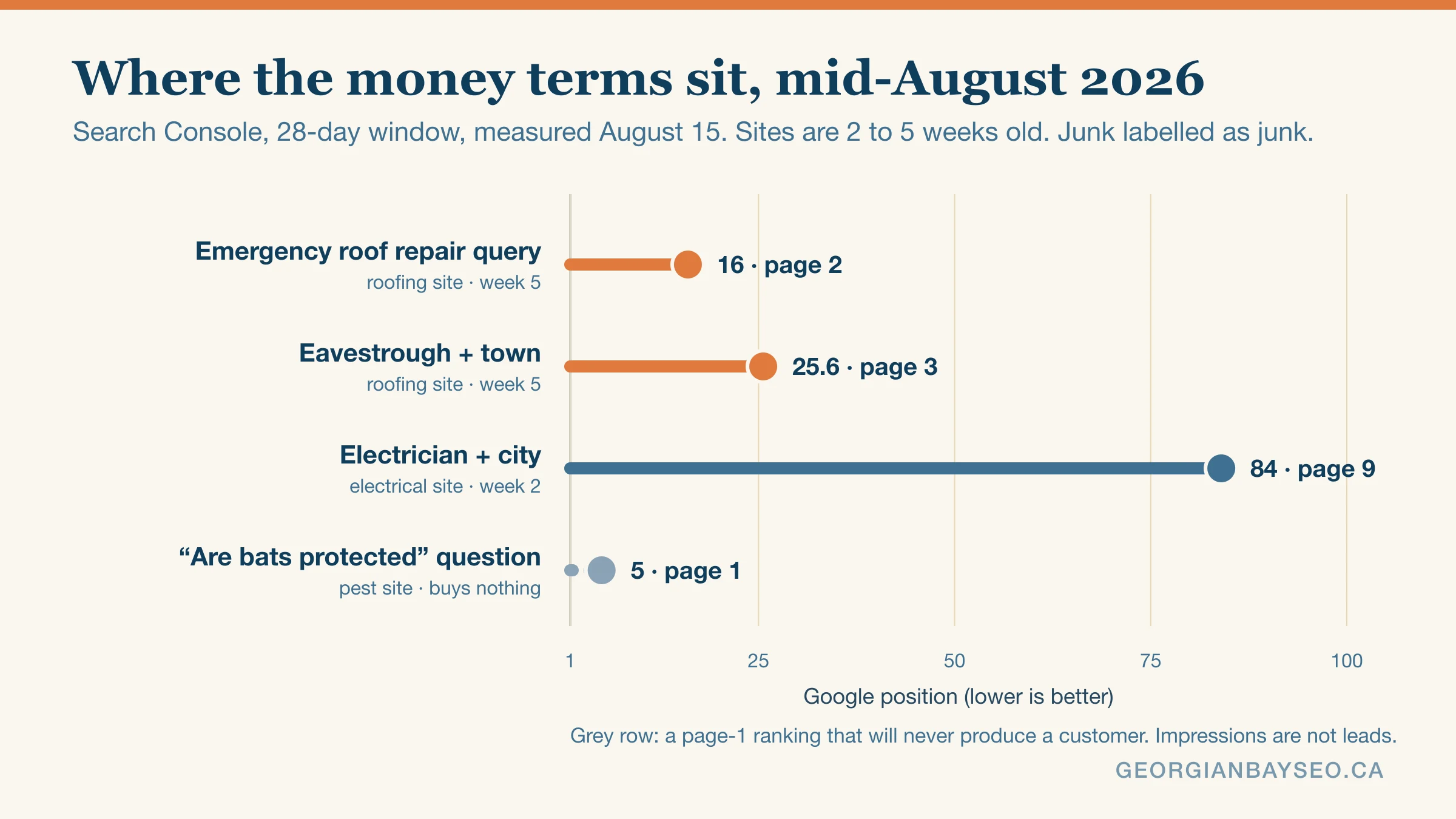
Site 1 (roofing and eavestrough, launched July 12) is the furthest along. It went from 0 impressions in late July to 99 impressions in a single day by August 13. Its eavestrough-plus-town money term sits at position 25.6, and an emergency roof repair query is already at position 16. That is page 3 and page 2 territory inside five weeks, with zero links.
The raw impression counts on the younger sites are mostly junk, and I want to be honest about that. The electrical site leads the portfolio with 803 impressions, but the bulk of them are informational queries from outside its service area. Its actual money term, the trade plus its city, sits at position 84. One pest control site reached page 1 for a wildlife-law question that will never produce a customer. If I only showed you impression graphs, this portfolio would look further ahead than it is. Impressions are not leads.
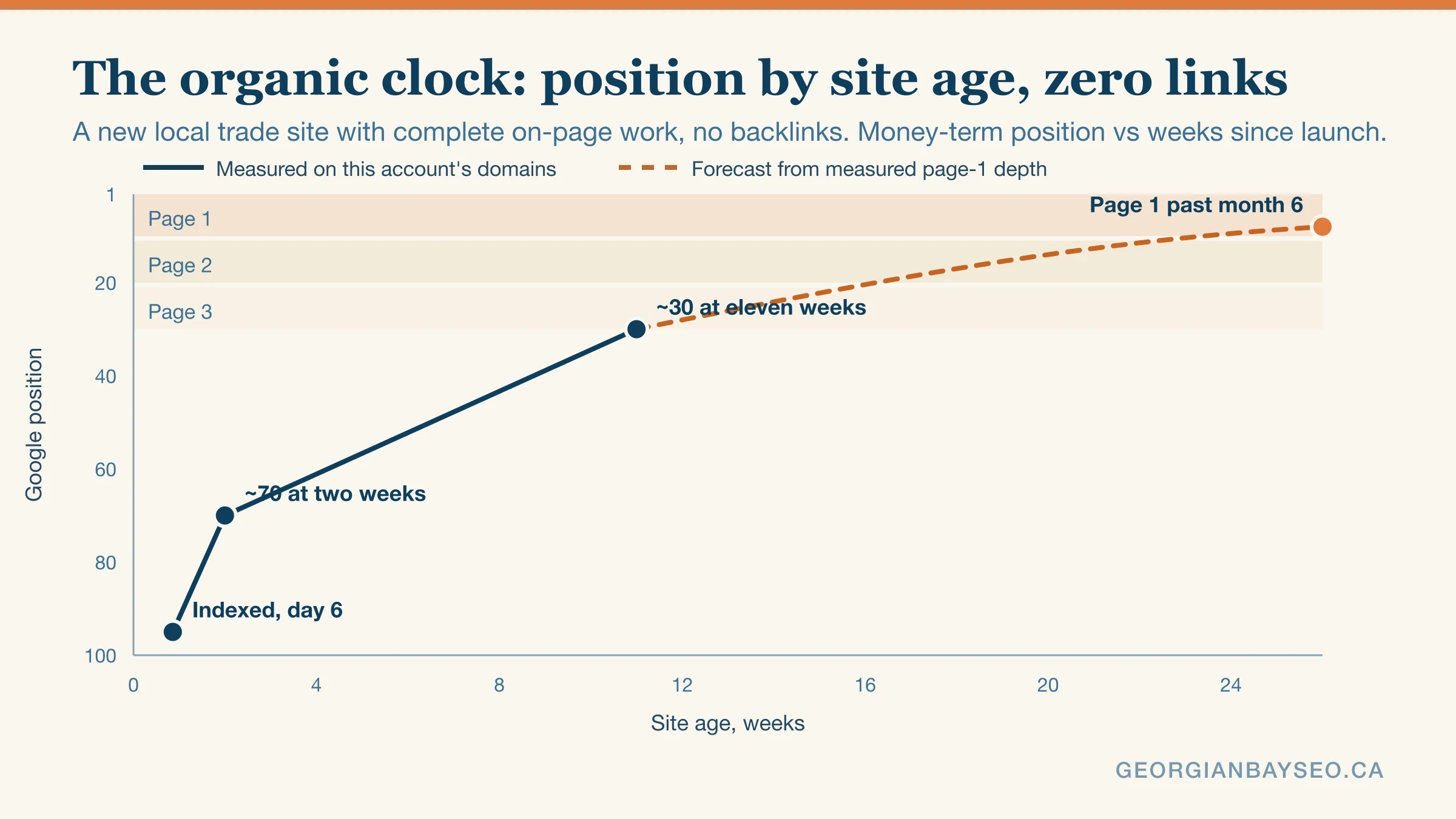
The organic clock is measurable and repeatable. Across my own domains, the pattern has been consistent: indexed in about 6 days, position around 70 at two weeks, around 30 at eleven weeks, and page 1 past the six-month mark. Based on the depth of each market’s page 1, my measured forecasts put these nine sites’ money terms on page 1 between roughly month 6 and month 12, which means between February and August 2027. This series will show whether those forecasts hold, market by market.
The first lead: day 40
On August 21, 2026, the first genuine lead arrived: a real homeowner with a real job, 40 days after the first site went live. One lead is not revenue and I will not pretend otherwise. But it is the proof that the whole pipe works end to end: a page written for a query, ranked with no links, found by a stranger, converted into a contact. Everything from here is a volume question, and volume follows position.
Why zero link building
Partly it is an experiment: if these sites rank, then on-page quality, market selection, and content matched to search intent are sufficient in these markets, and that is worth knowing precisely. Partly it is discipline: links are the easiest thing to buy and the easiest way to fool yourself about why something ranked.
To be clear, I am not against links. For an established local business, earned local links from suppliers, sponsorships, and trade associations are real and worth pursuing. But this series will show what the floor looks like without them, because that floor is what most local SERPs in Ontario are actually contested at.
What this means if you run a trade business
The uncomfortable version: a brand-new domain with no reviews, no history, and no links reached page 2 for an emergency query in your industry in five weeks. If your established business, with years of history and real reviews, is not on page 1 for your own trade and town, the gap is not authority. It is the on-page work. That gap is exactly what I look for in a free audit, and the full local playbook is in the Collingwood SEO guide.
Part 2 will cover the eleven-week positions across the portfolio and the market-grading method in detail, with the same rule this post follows: real dates, real numbers, junk labelled as junk.
FAQ
Is this rank and rent?
Yes, that is the model: I build and rank the site, and a local operator rents the leads it produces. For this series the model matters less than the mechanism. The ranking work is identical to what an agency does for a client site; the only difference is who owns the domain.
Why not name the sites and towns?
Because they are live commercial assets in contested markets. Publishing the domains would invite direct copies of pages I paid to research and write. The professions, dates, and Search Console figures are real; the towns stay described as local or regional.
Does zero link building mean links do not matter?
No. It means that in the local trade markets I selected, the current page-1 pages are weak enough that a better page can pass most of them without links. In deeper markets, links are still part of the job. Market selection is what makes the zero-link approach viable.
How much does one of these sites cost to run?
Under $100 per year in hosting and domain costs per site, plus the tracked phone number. The real cost is the content and structure work up front, which is exactly the work described in what local SEO costs in Ontario.
How long until a new local site produces leads?
On this portfolio: first lead at day 40, with the money terms forecast to reach page 1 between month 6 and month 12 depending on market depth. Any promise meaningfully faster than that, from anyone, should come with the measurement that backs it.
Want this run against your own business?
Free 15-minute audit. We pull up Google together and show you exactly where you rank, where you could be in 60 to 90 days, and the cheapest moves to get there.
Prefer to talk? (705) 539-0398